
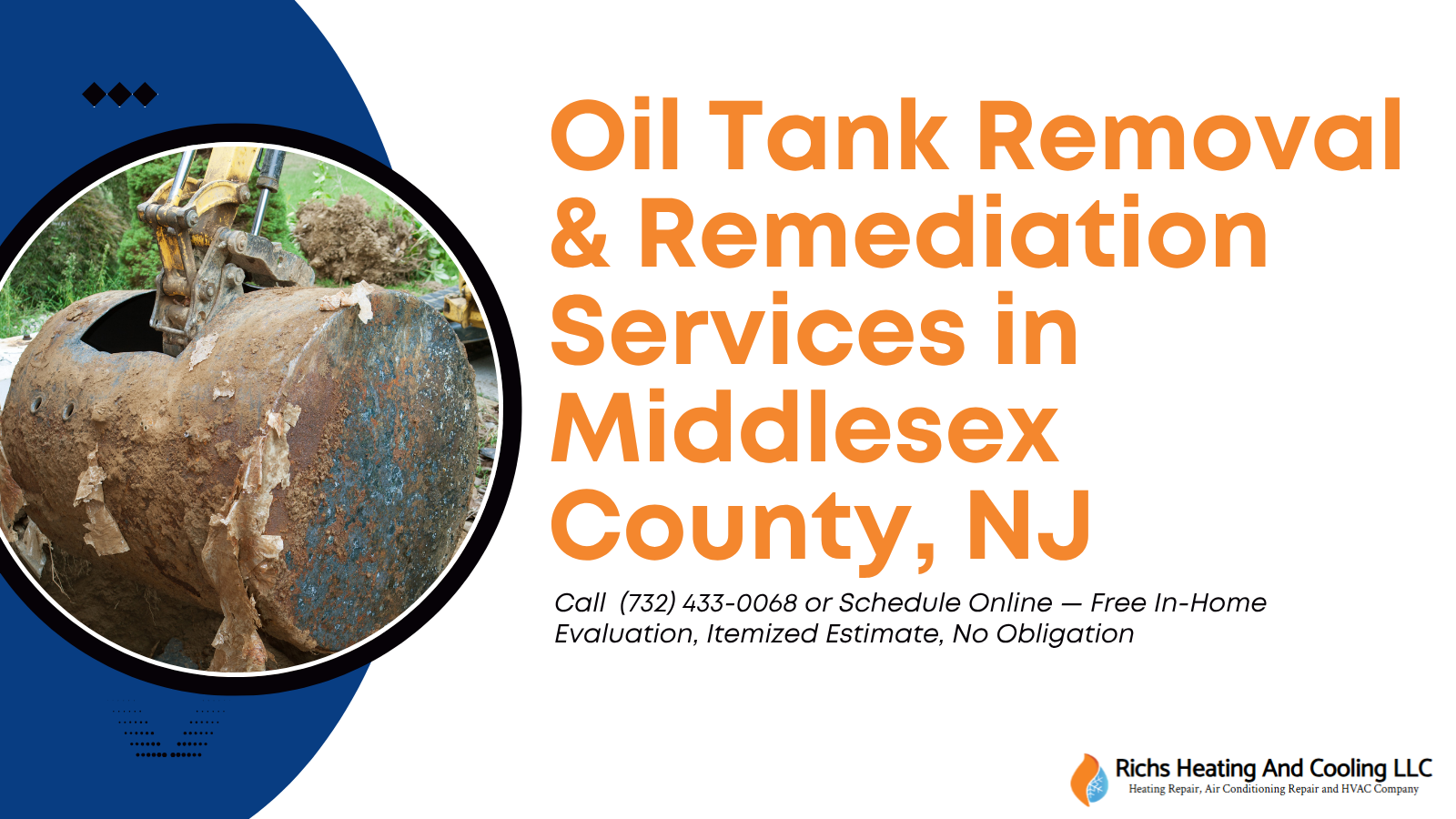
Oil Tank Removal & Remediation Services in Middlesex County, NJ
About This Service
Rich's Heating and Cooling LLC provides full-scope oil tank removal and remediation services across all 25 municipalities in Middlesex County, NJ. We locate, excavate, and extract above-ground and underground residential oil tanks, collect soil samples through a NJDEP-certified laboratory, and guide homeowners through the NJDEP Unregulated Heating Oil Tank (UHOT) process from start to finish — including support for obtaining a No Further Action (NFA) letter. Our team brings hands-on experience with Middlesex County properties, controlled excavation near foundations and driveways, and the documentation that buyers, lenders, and attorneys expect. Call (732) 433-0068 for a free quote.
Oil Tank Removal & Remediation in Middlesex County, NJ
Finding out you have an underground heating oil tank — especially mid-sale or during a renovation — is stressful. The right approach is straightforward: confirm what's on site, remove the tank safely, and test the surrounding soil so you're not guessing. In Middlesex County, Rich's Heating and Cooling LLC handles the full job: locating, excavation, extraction, soil sampling, NJDEP reporting coordination, and the paperwork that protects your property record.
Oil tank removal is not just about pulling a tank out of the ground. A professional removal confirms what's under your property, produces real lab data, and leaves you with documentation you can use for a sale, refinance, or buyer's inspection. Done correctly, it eliminates the uncertainty that derails real estate transactions and avoids the much larger cost of discovering a leak after the fact.
 What's Included in Our Oil Tank Removal & Remediation Services
Below is what a full-scope service typically includes for Middlesex County residential properties:
Oil tank sweep / locating: ground-penetrating radar or probing to confirm tank presence and position before any digging
Site evaluation and access planning around driveways, fencing, landscaping, and tight property lines
Safe excavation and tank extraction — controlled removal to prevent spills, especially on older corroded tanks
Handling and proper disposal of fill lines, vent pipes, and associated piping
Soil sampling and certified lab testing from the tank pit and surrounding areas where releases most commonly occur
Backfill, compaction, and site restoration including grading and surface repair
Clear removal documentation and soil lab results for your records
Explanation of next steps if soil testing indicates contamination, including NJDEP UHOT remediation guidance
NJDEP Certification, Licensing & Compliance
Oil tank removal and remediation in New Jersey is regulated under NJDEP's Unregulated Heating Oil Tank (UHOT) program (N.J.A.C. 7:14B) and requires coordination with NJDEP-certified laboratories for soil testing. Rich's Heating and Cooling LLC works with NJDEP UST closure-certified contractors and uses NJDEP-certified labs for all soil sample analysis — so your results are legally defensible and accepted by mortgage lenders, real estate attorneys, and NJDEP.
If a discharge is discovered during removal or investigation, New Jersey requires reporting through the WARNDEP Hotline: 1-877-WARN-DEP (1-877-927-6337). We are experienced in managing that notification process and guiding you through next steps under the UHOT framework.
No Further Action (NFA) Letter: What It Is and Why It Matters
The No Further Action (NFA) letter is the single most important document for homeowners dealing with a residential oil tank — especially in a real estate transaction. Issued by NJDEP after a confirmed cleanup or a determination that no remediation is necessary, the NFA letter tells mortgage lenders, buyers, and title companies that the property has been evaluated and no further environmental action is required.
Without an NFA letter, buyers' lenders frequently refuse to close, and sellers face renegotiated prices or deal collapses. Rich's Heating and Cooling LLC guides Middlesex County homeowners through the UHOT process to position you for NFA eligibility — from proper removal documentation to lab results and NJDEP reporting coordination.
Oil Tank Sweep & Locating Services
Many homeowners aren't sure whether they have an underground tank at all — especially on older properties that converted from oil to gas heat. An oil tank sweep uses ground-penetrating radar or probing techniques to locate buried tanks before any excavation begins.
Rich's Heating and Cooling LLC offers oil tank sweeps as a standalone service for Middlesex County homeowners who want to confirm their property status before listing, buying, or beginning a renovation. If the sweep confirms a tank is present, we plan the removal from there. If no tank is found, we document that too.
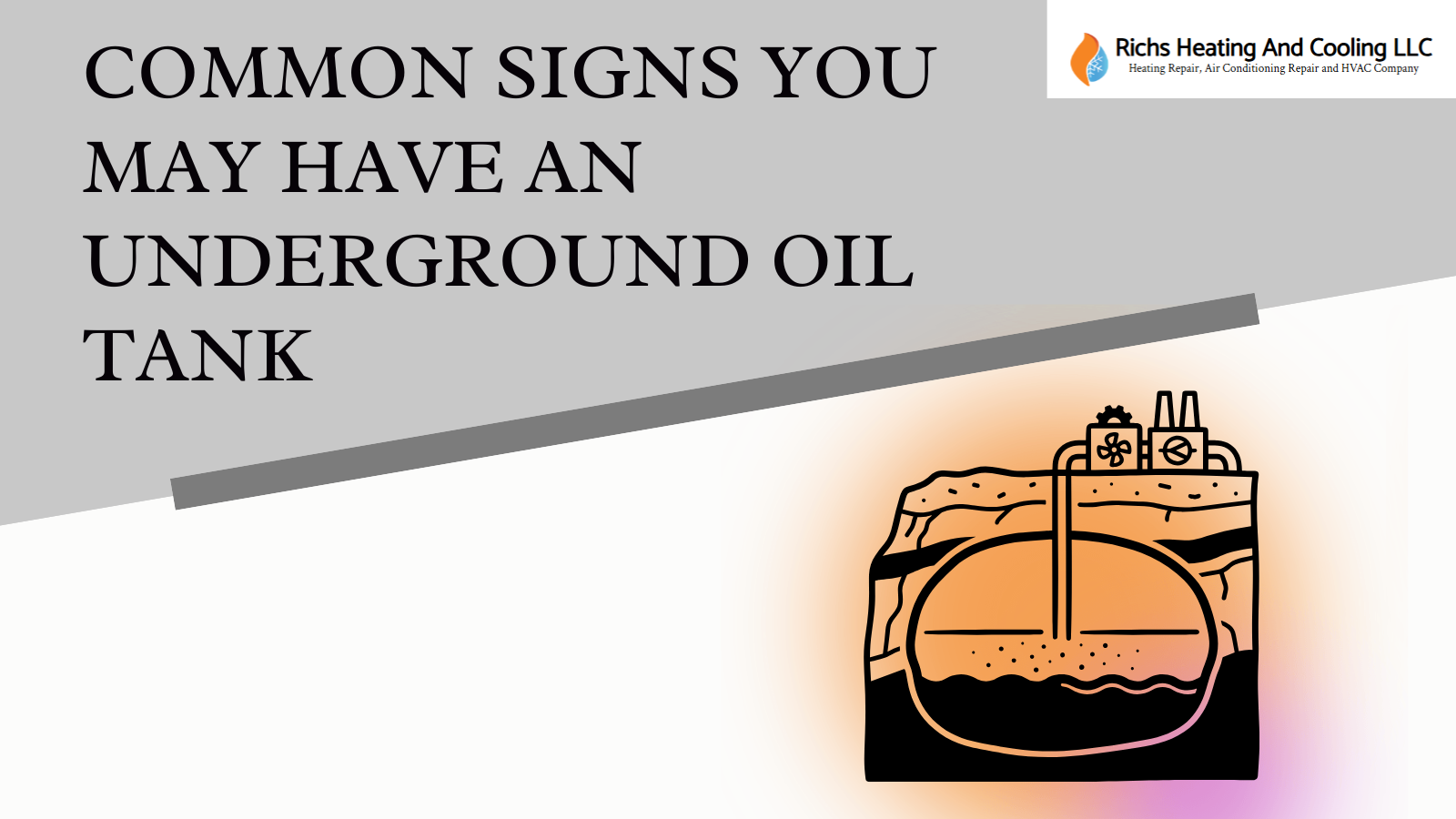 Common Signs You May Have an Underground Oil Tank
Most homeowners spot clues before they ever see a tank. If you notice any of the following on your Middlesex County property, arrange a site assessment before a sale, renovation, or major landscaping project:
A fill pipe near the foundation, driveway, or side yard — sometimes cut off close to the ground
A vent pipe that doesn't connect to current equipment
Old oil lines entering the basement or crawl space
A depression or soft spot in the yard where a tank may have settled
Petroleum odors after rain, thaw, or digging
Home history showing conversion from oil to gas heat, especially pre-1980s construction
Above-Ground vs. Underground Oil Tanks: Key Differences
The removal process, cost, and regulatory treatment differ between above-ground storage tanks (ASTs) and underground storage tanks (USTs):
Why Removal Matters — Even If the Tank Seems Inactive
An abandoned oil tank that appears dormant can still contain residual oil and sludge. As the tank corrodes, petroleum compounds can migrate through the soil and reach groundwater pathways. This is why removal is a property-protection decision, not just a mechanical one.
Costs also escalate the longer an issue goes unaddressed. A small leak discovered during a proactive removal is typically far less expensive to remediate than one discovered during a real estate transaction under time pressure, or reported by a neighbor after it reaches their property.
 Oil Tank Removal Process — Step by Step
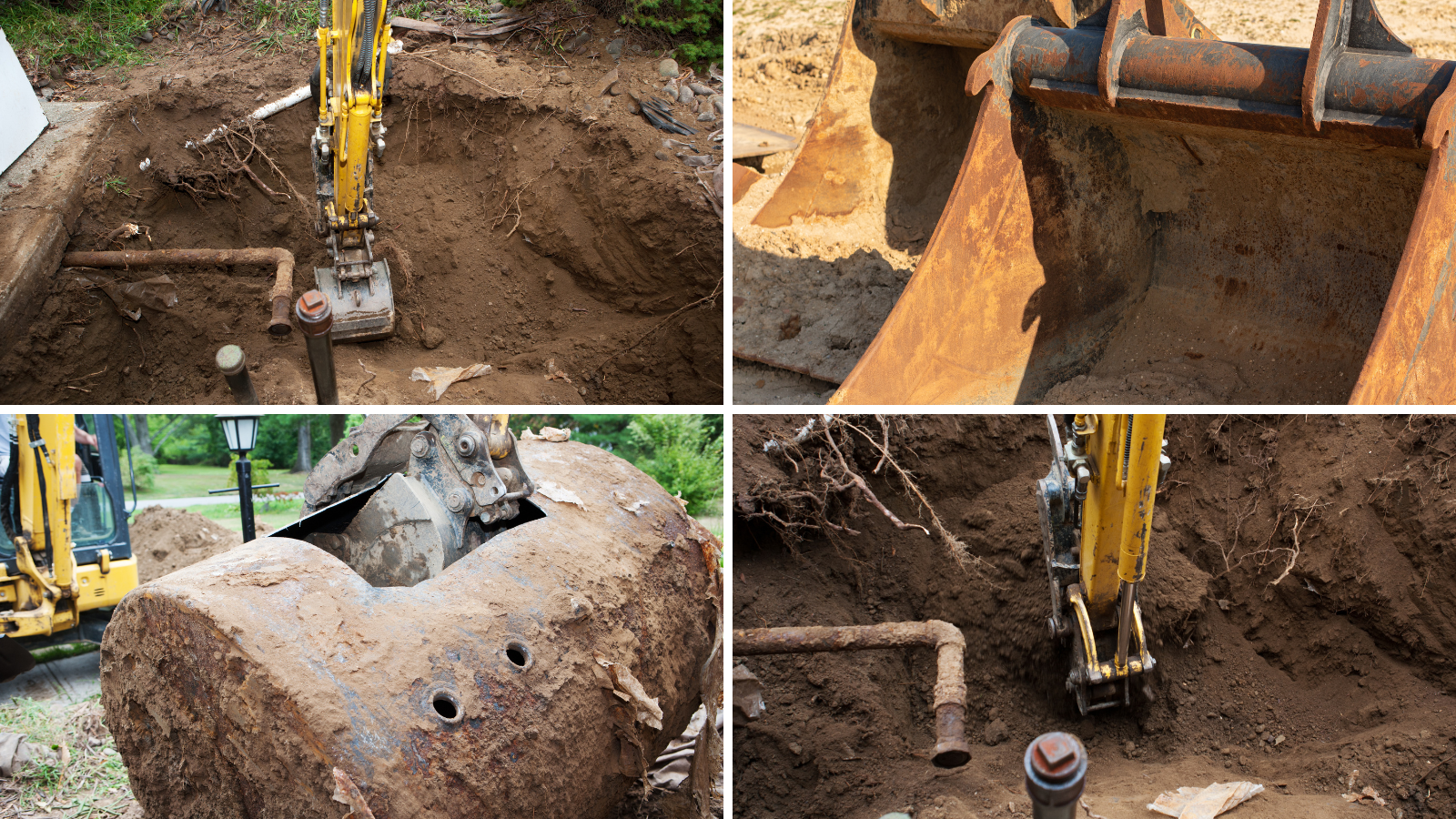
A proper removal is planned, not rushed. Here is the standard sequence for Middlesex County residential properties:
Step 1: Oil tank sweep and site assessment. We confirm whether a tank is present using radar or probing, identify likely tank size and location, and review access constraints including driveways, gates, and proximity to the foundation. We look for fill/vent pipes, old oil lines, and early signs of past leakage.
Step 2: Planning and local permit guidance. Some Middlesex County municipalities have specific expectations for excavation, restoration, and inspections. We explain what is commonly required for your town and what documentation to retain.
Step 3: Excavation and tank extraction. We prepare the work area and excavate to expose the tank. Lines are carefully disconnected and the tank is removed in a controlled manner to minimize spill risk — especially important on older, corroded tanks.
Step 4: Soil sampling and certified lab testing. Soil samples are collected from the tank pit — particularly beneath the tank and near the ends where releases most commonly occur. Samples go to a NJDEP-certified laboratory for analysis.
Step 5: Backfill, compaction, and site restoration. We backfill and compact the excavation correctly to stabilize the area, including rough grading, topsoil placement, and coordination for surface restoration.
Step 6: Documentation and next-step recommendations. You receive removal documentation and certified soil lab results. If contamination is found, we explain remediation options and NJDEP UHOT reporting steps. We support the process toward obtaining a No Further Action (NFA) letter when eligible.
Remediation Techniques Explained
Not every removal leads to remediation. Many Middlesex County tanks come out with clean soil tests. When remediation is required, the method depends on lab results, the extent of impact, and site conditions under NJDEP's UHOT framework.
Targeted Soil Excavation and Off-Site Disposal
The most common solution when impacts are localized. Impacted soil is excavated from the tank pit and visibly affected areas, then transported for proper disposal. Confirmatory samples are collected after excavation to verify remaining soil meets cleanup standards before backfilling.
In-Place Treatment for Lighter Impacts
When impacts are present but limited, certain sites can be addressed without removing large soil volumes. In-place treatment focuses on breaking down petroleum compounds over time, documented by follow-up sampling. This is recommended only when site conditions and lab results support it.
Soil Vapor Extraction (SVE) for Vapor Concerns
When volatile petroleum compounds present a vapor migration concern, soil vapor extraction may be used. SVE applies a controlled vacuum to pull vapors from the subsurface for treatment. This is site-specific and used when conditions indicate it is appropriate.
Groundwater Response (When Applicable)
Most residential oil tank issues remain in shallow soil. If deeper migration is indicated, the scope expands with additional sampling to define the extent before remediation planning proceeds.
NJDEP PUST Fund: Financial Assistance for Eligible Homeowners
The NJDEP Petroleum Underground Storage Tank (PUST) Remediation Fund provides grants and loans to eligible New Jersey homeowners whose tanks have leaked. If you discover a discharge during removal and meet the eligibility criteria, the PUST Fund may offset a significant portion of remediation costs.
Rich's Heating and Cooling LLC can explain whether your situation may qualify and what documentation the PUST Fund application requires. Contact the NJDEP Site Remediation Program for current program details: dep.nj.gov/srp/unregulated/
Oil Tank Removal Cost in Middlesex County, NJ
Oil tank removal in Middlesex County, NJ typically costs between $4,000 and $8,000 for a standard residential underground tank, with soil testing adding $800–$2,500. Remediation costs extra if contamination is found. The table below shows planning ranges — call (732) 433-0068 for a site-specific quote.
What Pushes the Price Up
Cost increases when the tank sits under a driveway, near tight property lines, behind fencing, or deeper than expected. Tanks near foundations require more controlled excavation. If a discharge is discovered, remediation scope and cost are driven by lab results and NJDEP cleanup requirements.
The fastest way to narrow the number: confirm the tank location, access, and whether staining or odors suggest a prior release.
Service Area Spotlight: Middlesex County Oil Tank Removal by Town
Rich's Heating and Cooling LLC serves all 25 municipalities across Middlesex County, NJ. Here is a look at oil tank removal in our most active service towns:
Oil Tank Removal in Edison, NJ
Edison's older neighborhoods — particularly those built in the 1940s–1970s — are among the most active areas for residential oil tank discovery in Middlesex County. Many properties converted from oil to gas heat decades ago, leaving behind tanks that were simply abandoned rather than removed. Rich's Heating and Cooling LLC regularly serves Edison homeowners with full-scope removal, soil testing, and NJDEP compliance coordination.
Oil Tank Removal in Woodbridge, NJ
Woodbridge's mix of ranch homes and colonial-era properties frequently surfaces oil tanks during pre-sale inspections and renovation projects. Rich's Heating and Cooling LLC provides Woodbridge homeowners with documented removal and certified soil results to satisfy buyers and lenders.
Oil Tank Removal in New Brunswick, NJ
New Brunswick properties — particularly older multi-family and converted single-family homes near the city core — regularly have legacy oil tanks from pre-natural-gas infrastructure. Our team handles tight-access urban excavations throughout New Brunswick with proper documentation for all stakeholders.
Oil Tank Removal in Piscataway, NJ
Piscataway's suburban residential stock includes significant pre-1980s housing with abandoned heating oil tanks. Whether you're preparing for a sale, refinance, or renovation, Rich's Heating and Cooling LLC serves Piscataway homeowners from tank sweep through final soil testing and NFA letter support.
Oil Tank Removal in Old Bridge, NJ
Old Bridge's sprawling residential communities — many built during the postwar oil-heat era — frequently encounter legacy tanks during home sales. Rich's Heating and Cooling LLC provides Old Bridge property owners with comprehensive removal services and soil lab documentation to keep real estate transactions on track.
Oil Tank Removal in Dunellen, NJ
As our home base, Dunellen is a community we know well. Rich's Heating and Cooling LLC has served Dunellen homeowners with oil tank removal, soil testing, and remediation coordination throughout the borough's older residential neighborhoods. Call (732) 433-0068 — we're local.
Frequently Asked Questions
How do I know if I have an underground oil tank?
Look for a fill pipe or vent pipe near the foundation, evidence of old oil lines entering the home, or property records indicating prior oil heat use. An oil tank sweep using ground-penetrating radar or probing can confirm whether a tank is buried before any excavation begins.
What is the UHOT program in New Jersey and how does it affect oil tank removal?
The NJDEP Unregulated Heating Oil Tank (UHOT) program governs the investigation and remediation of discharges from residential heating oil tanks in New Jersey. If a leak is discovered during removal, the UHOT framework guides what sampling, reporting, and cleanup steps are required. Rich's Heating and Cooling LLC is experienced in the UHOT process and can explain what it means for your specific situation.
How do I get a No Further Action (NFA) letter for my oil tank in New Jersey?
An NFA letter is issued by NJDEP after a cleanup is completed or after a determination that no remediation is necessary following proper evaluation. To be eligible, the tank removal and soil testing must be documented correctly and submitted through the appropriate NJDEP process. Rich's Heating and Cooling LLC guides Middlesex County homeowners through the documentation and reporting steps required to pursue NFA eligibility.
Do I need a licensed contractor to remove an oil tank in NJ?
Yes. Underground tank closure in New Jersey requires compliance with NJDEP regulations (N.J.A.C. 7:14B) and the use of NJDEP-certified labs for soil testing. Using an unlicensed or uncertified contractor can produce documentation that is rejected by NJDEP, lenders, and real estate attorneys — creating problems that cost far more to fix than the original job.
What is the difference between oil tank removal and oil tank abandonment in place?
Removal means the tank is physically excavated and extracted. Abandonment in place historically involved filling the tank with sand or concrete and leaving it buried. Most real estate lenders and buyers today require full removal with soil testing documentation — abandonment records are often insufficient for a clean property sale in New Jersey.
Does homeowner's insurance cover oil tank removal or remediation in NJ?
Standard homeowner's policies typically exclude gradual pollution events like oil tank leaks. Some insurers offer specific UST or pollution endorsements. Review your policy with your insurer. The NJDEP PUST Remediation Fund may also provide financial assistance to eligible homeowners with confirmed discharges — see the financial assistance section above.