

Repair your furnace if it is fairly new, the problem is isolated, and the cost is modest compared with a new unit. Consider replacement if it is 15 to 20 years old, needs repeated repairs, or has a safety issue such as a cracked heat exchanger, and always have a licensed technician inspect it first.
So, should you repair or replace your furnace when the heat cuts out in the middle of a cold week? The honest answer depends on the furnace's age, the repair quote, its track record, and, most importantly, whether it is still safe to run.
This guide shows how to weigh a residential HVAC repair against a new installation without guessing. It also explains the 50% rule and the $5,000 rule, and where those shortcuts fall short.
 Key Takeaways
Here are the main points that shape most repair-or-replace decisions. Each one is covered in more depth below.
None of these points works alone, because age, condition, and safety all affect one another. A 12-year-old furnace with a failing blower motor is a very different case from one with a cracked heat exchanger.
-Age matters, but condition, repair history, safety, and remaining service life count too.
-Consider replacement when a repair approaches 50% of the cost of a new furnace, especially for an older system.
-The $5,000 rule multiplies furnace age by repair cost and is a screening tool, not a diagnosis.
-A cracked heat exchanger or carbon monoxide risk overrides cost math, so turn the system off and arrange emergency heating repair.
-Compare the full installed scope of any replacement quote, which is what a residential HVAC installation estimate should itemize.
-Homeowners planning to stay for many years have more time to recover the cost of a higher-efficiency furnace.
 When Furnace Repair Usually Makes Sense
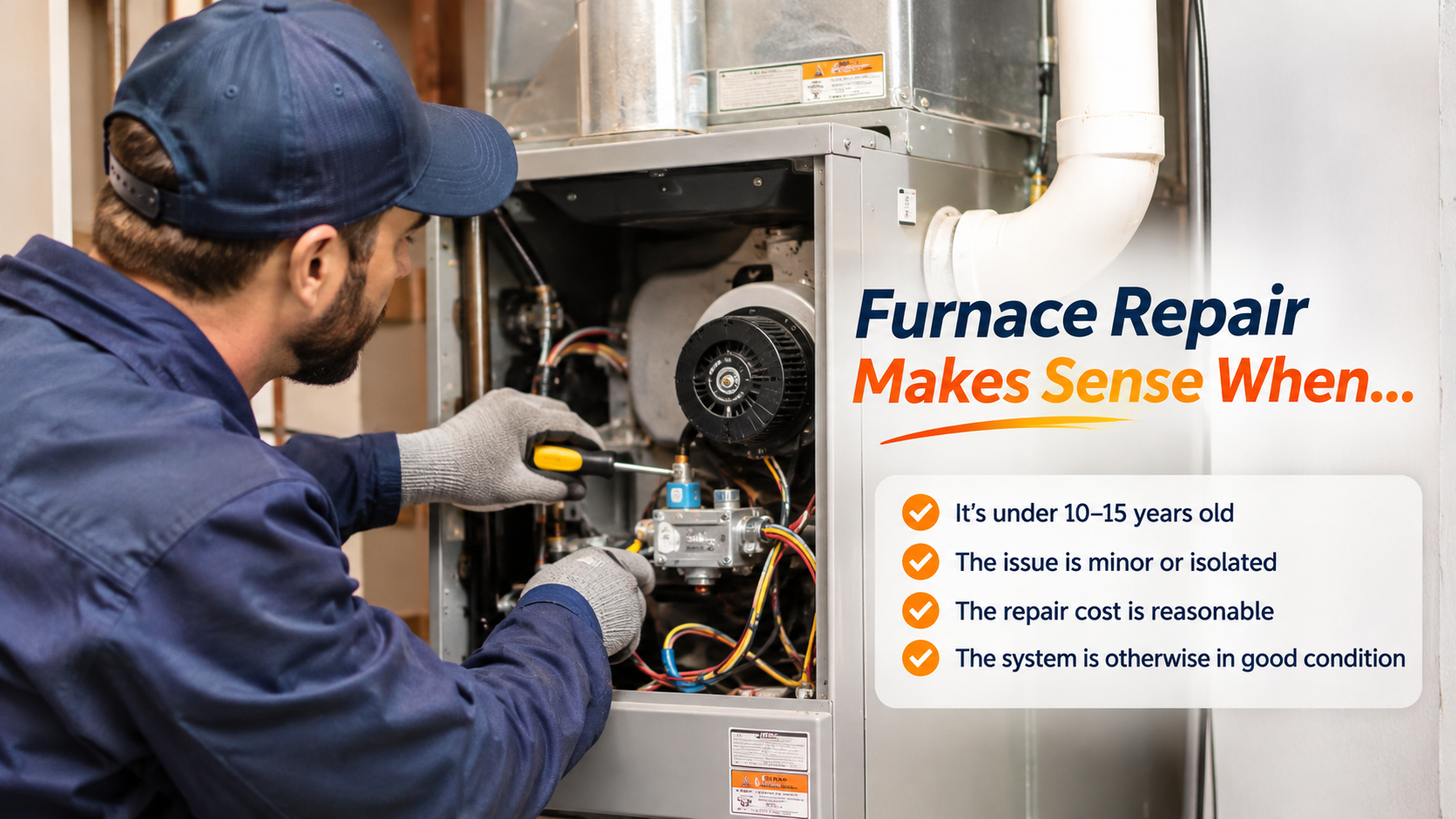
Repair is often the better choice when the furnace is otherwise sound and the problem is isolated. In those cases, fixing one failed part costs far less than replacing a system with years of service left.
"Otherwise sound" means the heat exchanger, venting, and safety controls are in good shape. A technician can confirm that during a furnace repair visit.
-The furnace is under roughly 10 to 15 years old.
-The problem is minor or isolated, such as an ignition issue, thermostat problem, clogged filter, or one failed component.
-The repair cost is reasonable compared with the furnace's remaining life.
-The heat exchanger, venting, and safety controls are in good condition.
-The furnace has had regular residential HVAC maintenance.
A $250 igniter repair on a 7-year-old furnace with no other major issues is often a sensible repair. The cost is small, and most of the furnace's service life is still ahead of it.
When Furnace Replacement Is Usually the Better Choice
Replacement deserves serious consideration when repairs, reliability problems, efficiency losses, or safety concerns suggest the furnace is nearing the end of its service life. At that point, each new repair tends to buy less time than the last.
Age alone does not require replacement, which is why a technician's inspection and a written furnace installation estimate matter more than the nameplate. Even one serious sign, such as a failed heat exchanger, can be enough on its own.
-The furnace is roughly 15 to 20 years old.
-The repair estimate approaches 50% of the installed cost of a comparable new furnace.
-The system has needed multiple repairs in the past two heating seasons.
-Energy bills are rising even though usage and maintenance have stayed about the same.
-The home has persistent uneven heating, weak airflow, short cycling, or unusual noises.
-Parts are obsolete or unavailable, or a major component such as the heat exchanger has failed.
When the numbers point toward replacement, look for the ENERGY STAR label, since certified gas furnaces in the northern half of the U.S. can be up to 15 percent more efficient than baseline models. It is also worth asking about alternatives such as heat pump services where one could work.
The Repair vs. Replace Decision Framework
The simplest way to decide is to compare your furnace against seven factors side by side. When most rows lean the same direction, the answer is usually clear.
The table turns the last two sections into a quick checklist. If you want a second opinion on any row, a licensed HVAC contractor can confirm the furnace's condition.
No single row decides the outcome, so give safety the most weight. If the rows are evenly split, ask for a written inspection report.
 Two Rules of Thumb: The 50% Rule and the $5,000 Rule
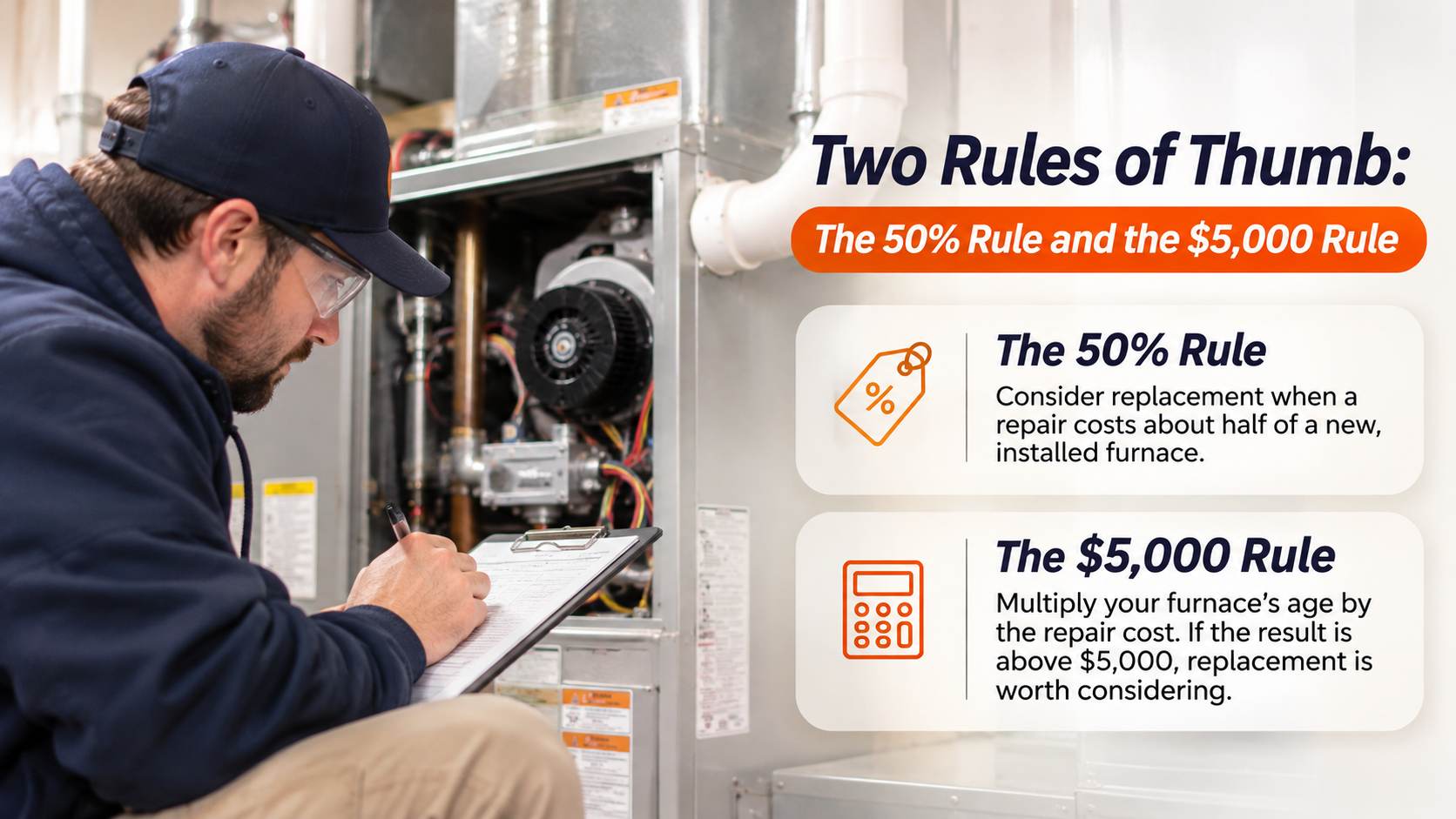
Two quick calculations can help you screen a repair quote: the 50% rule and the $5,000 rule. Both are rules of thumb, not laws, and neither replaces a professional diagnosis.
The 50% rule says to consider replacement when a single repair quote approaches half the cost of installing a comparable new furnace. Compare against the full installed cost, not just the price of the equipment.
The $5,000 rule multiplies your furnace's age by the repair estimate. If the result is above $5,000, replacement is worth considering, and if it is below, repair may be reasonable, as Trane explains.
A 15-year-old furnace with a $400 repair scores $6,000 (15 × $400), which suggests replacement deserves consideration. A 4-year-old furnace with the same repair scores $1,600 (4 × $400), which favors repair.
Both rules share some blind spots. Keep these in mind when you run the numbers.
-Neither accounts for safety problems, which can make replacement the right call at any score.
-Neither measures efficiency or a pattern of repeated breakdowns.
-Neither reflects the full installed scope of a replacement, such as venting, electrical work, and permits.
CBS News describes the $5,000 rule as a simple guideline, not a final answer. The same math applies to other equipment too, such as an air conditioner that stopped blowing cold air.
Furnace Age: What Is Normal?
Many gas furnaces last roughly 15 to 20 years, but there is no fixed expiration date. Maintenance, installation quality, climate, and how hard the system runs all change how long a furnace holds up.
According to Carrier's furnace lifespan guide, most residential furnaces last 15 to 20 years, and regular service can often extend that. Carrier's repair guidance suggests weighing replacement around 10 years while Bryant uses a 15 to 20 year window, so "consider replacement" does not mean "replace immediately."
-0 to 10 years: Repair is often sensible for isolated issues.
-10 to 15 years: Evaluate repair cost, efficiency, reliability, and the risk of upcoming repairs.
-15 to 20 years: Give replacement greater weight, especially with major repairs or declining performance.
-Any age: Safety concerns can make replacement the right recommendation.
Safety Issues That Change the Decision
A safety problem should never be treated as an ordinary cost-benefit decision. If a technician finds a cracked heat exchanger, a combustion problem, or a venting failure, the furnace should stay off until the issue is resolved.
Furnaces burn fuel, and fuel-burning equipment can produce carbon monoxide, a colorless and odorless gas. The Consumer Product Safety Commission lists heating equipment among the top contributors to carbon monoxide deaths from consumer products and urges a yearly professional inspection.
-A cracked or compromised heat exchanger.
-Combustion or venting problems, such as a yellow flame, soot, or a loose or disconnected vent.
-Signs of carbon monoxide risk, including an alarm that goes off.
-Gas odor, scorching, corrosion, water leakage, electrical hazards, or repeated safety-control shutdowns.
If a carbon monoxide alarm sounds, get everyone outside to fresh air and call 911 before doing anything else. The CPSC's carbon monoxide questions and answers page explains the hazard, and you can request a furnace inspection if you want a second look.
Furnace Repair Costs vs. Replacement Costs
Costs vary widely by home, equipment, and location, so no single price is accurate for everyone. The most reliable approach is to ask for itemized quotes.
A repair estimate usually covers a diagnostic fee, parts, and labor, while a replacement estimate covers far more. That is why the two numbers can look so far apart at first.
-A diagnostic fee, and whether it is credited toward the repair.
-Parts, labor, permits, and any emergency or after-hours charges.
-The full replacement scope: the furnace, installation, removal of the old unit, venting, gas work, condensate drainage, controls, duct modifications, and startup testing.
-Electrical work, which matters even more with some systems, such as ductless mini-splits and their amperage requirements.
-Warranty terms for both parts and labor.
Fuel savings from a higher-AFUE furnace depend on your climate, fuel prices, and home, and the U.S. Department of Energy explains AFUE ratings for furnaces and boilers. Rebates change often, so check current utility and state offers before you count on any savings.
Questions to Ask Before You Decide
Good questions turn a vague quote into a clear decision. Use the lists below with every contractor so you are comparing like with like.
A good technician will welcome them and answer plainly. Vague answers are a sign to get a second opinion.
Before approving a repair
-What exactly failed, and what evidence supports that diagnosis?
-Does the repair fix the root cause or only the symptom?
-What is the total out-the-door cost, including parts, labor, tax, and trip charges?
-Is the part under warranty, and are replacement parts readily available?
-What condition are the heat exchanger, burners, blower, venting, and safety controls in?
-How likely is another major repair in the next one to three years?
Before replacing a furnace
-Is the furnace correctly sized for the home, not just matched to the old unit?
-What AFUE rating is proposed, and what does it mean for fuel use?
-What work is included: removal, venting, condensate drainage, electrical work, duct changes, thermostat, permits, and startup testing?
-What warranty covers parts, labor, and the heat exchanger?
-Will the contractor verify temperature rise, static pressure, fuel input, combustion safety, and airflow after installation?
-What financing, rebates, or incentives may apply, if any?
It also helps to see similar work, so ask for examples such as recent projects. If part of the home could be served by a ductless system, this comparison of Mitsubishi and Daikin mini-splits is a useful starting point.
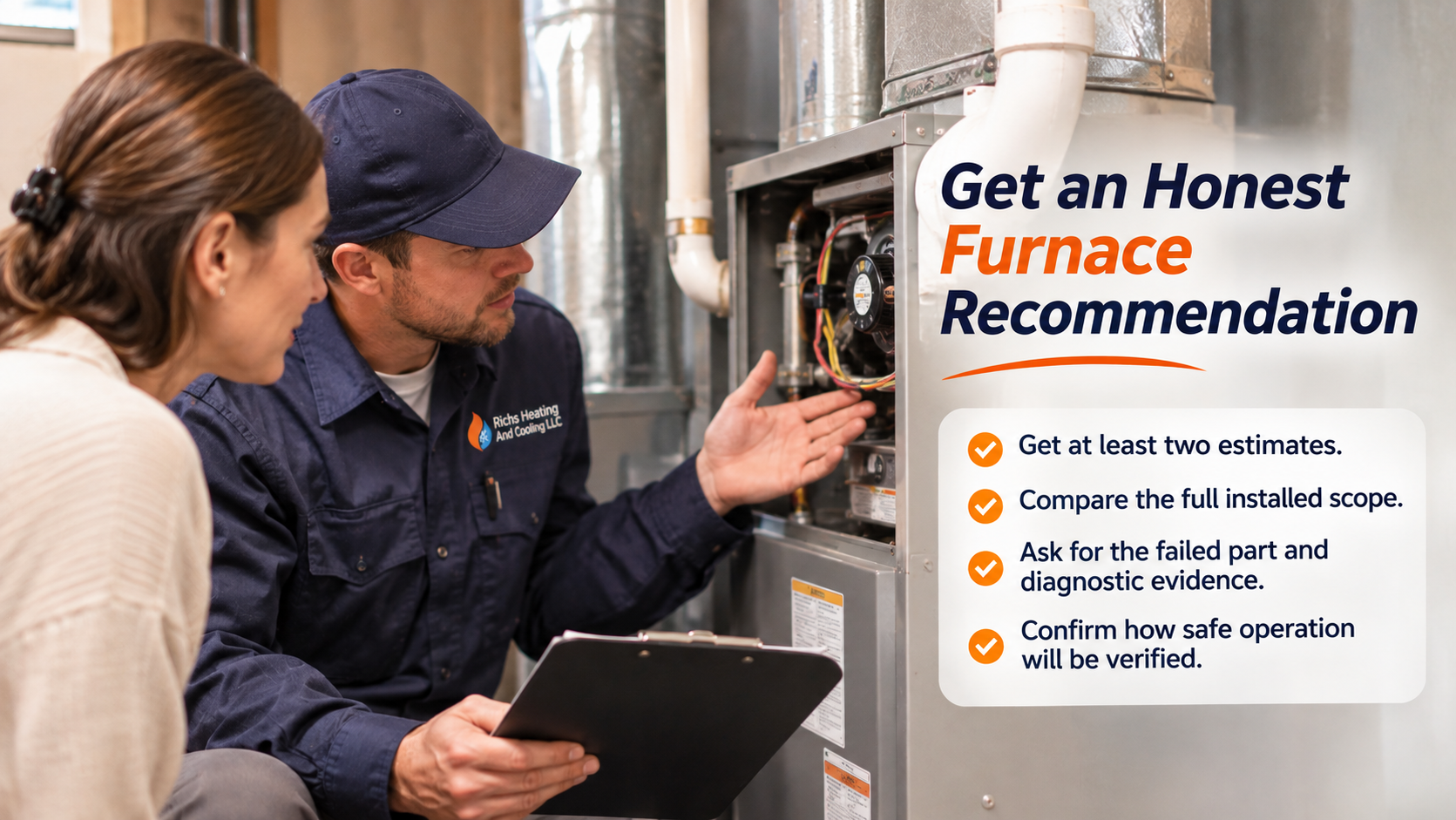 How to Get an Honest Furnace Recommendation
A trustworthy contractor separates the immediate repair, any reliability improvements, and the recommendation to replace. They provide written findings and itemized options, and they explain clearly why replacement is, or is not, necessary.
Before hiring anyone, read about the company's background and experience and the work on its services page. Both help you judge whether the contractor handles furnace work regularly.
-Request at least two estimates for a major replacement.
-Compare the full installed scope, not just the equipment price.
-Ask for the failed part and the diagnostic evidence in writing.
-Ask how the contractor will verify safe operation after installation.
Furnace Repair vs. Replacement: Frequently Asked Questions
These are the questions homeowners ask most often when deciding between repair and replacement. Each answer is kept short so you can find what you need quickly.
For anything that touches your specific furnace, an on-site inspection will always be more reliable than general guidance. Treat these answers as a starting point for that conversation.
How long does a furnace usually last?
Many gas furnaces last about 15 to 20 years. Maintenance, installation quality, usage, and local conditions all affect the actual service life.
Is it worth repairing a 20-year-old furnace?
Sometimes, but only if it is otherwise safe, reliable, and the repair is modest. At 20 years, replacement deserves stronger consideration, especially if repairs are expensive or recurring.
What is the 50% rule for furnace repair?
It is a rule of thumb: consider replacement when a repair approaches half the cost of a comparable new furnace installation. It works best when you weigh it alongside age, repair history, and safety.
What is the $5,000 rule for a furnace?
Multiply the furnace's age by the repair estimate, and if the result is over $5,000, replacement is worth considering. It is a screening tool, not a substitute for a professional inspection.
Is a cracked heat exchanger dangerous?
It can be. A cracked heat exchanger may allow combustion gases to mix with household air, so a qualified HVAC professional should evaluate it promptly.
Does a new furnace lower energy bills?
It can, particularly if the existing furnace is old, inefficient, poorly maintained, or improperly sized. Actual savings depend on fuel prices, climate, insulation, ductwork, thermostat settings, and installation quality.
Can I just replace the furnace and keep my air conditioner?
Sometimes, equipment compatibility, refrigerant requirements, coil compatibility, airflow, and system matching must be evaluated. Do not assume the existing outdoor unit can stay, and if it is also struggling, ask about air conditioning repair options during the same visit.
Furnace Repair and Replacement Help in Dunellen and Nearby Communities
Homeowners across central New Jersey face these same decisions, often when the first cold snap exposes a weak furnace. Permit requirements and utility incentives differ from town to town, so ask your contractor to confirm what applies at your address.
Rich's Heating and Cooling is based in Dunellen and serves Dunellen, Elizabeth, Plainfield, and the surrounding area. Its service-area pages also cover Metuchen, Old Bridge, New Brunswick, East Brunswick, South River, Cranbury, and North Brunswick, and you can browse them all on the service areas page.
Make the Decision With Confidence
The best repair-or-replace decision combines the furnace's age, the repair cost, its track record, and above all its safety. If the furnace is young and the problem is isolated, repair usually wins, and if it is aging, unreliable, or unsafe, replacement deserves a serious look.
No rule of thumb replaces an on-site inspection, so get written findings before you commit to either path. If you would like a professional opinion, you can call (732) 433-0068 to schedule a furnace inspection or request a repair or replacement estimate.
Comments