

New Jersey homeowners shopping for a new furnace quickly discover that "furnace" no longer means one single product. Manufacturers now offer single-stage, two-stage, and variable-speed systems, each built around a different approach to comfort, noise, and efficiency. Choosing the right one depends less on brand names and more on your home's layout, ductwork, budget, and how long you plan to stay in the property. This guide breaks down how each furnace type works and which situations call for which option.
Quick answer: Single-stage is usually the simplest and least expensive option. Two-stage often delivers the best balance of cost and comfort. Variable-speed equipment offers the most refined comfort and airflow control, but it has the highest upfront cost and requires careful installation.
A single-stage furnace may be appropriate for homeowners prioritizing the lowest upfront cost, especially in smaller homes, rental properties, vacation homes, or homes with relatively even heating. A two-stage furnace is often a practical middle-ground choice for homeowners who want better comfort, quieter operation, and improved efficiency without paying the premium for a fully modulating system. A variable-speed furnace can be a strong choice for homeowners who prioritize consistent temperatures, lower operating noise, and premium comfort, but only when the system is properly sized and installed. Correct sizing, ductwork condition, and installation quality often matter just as much as the furnace type itself.
 How Furnace Staging and Blower Speed Work
Homeowners often mix up two separate concepts when comparing furnace options: heating stages and blower speed. Heating stages describe how much heat the burner or gas valve produces during a cycle. Blower speed describes how the indoor fan moves air through your ductwork once that heat is produced. Understanding the difference makes it much easier to compare quotes from different contractors.
The terms "single-stage," "two-stage," and "modulating" generally refer to burner or gas-valve operation. The terms "fixed-speed," "multi-speed," and "variable-speed" refer to the blower motor instead.
Here is a simple way to picture the difference between the options.
• A single-stage furnace generally operates at full heating output whenever it turns on
• A two-stage furnace can run at a lower output during milder conditions and increase output when more heat is needed
• A modulating furnace adjusts output in smaller, more gradual increments
• A variable-speed blower can gradually adjust airflow to match system demand and ductwork conditions
A furnace can have a variable-speed blower while still using a single-stage or two-stage gas valve. This distinction matters when comparing quotes, since "variable-speed" on its own does not tell you how the burner operates.
 Single-Stage Furnaces
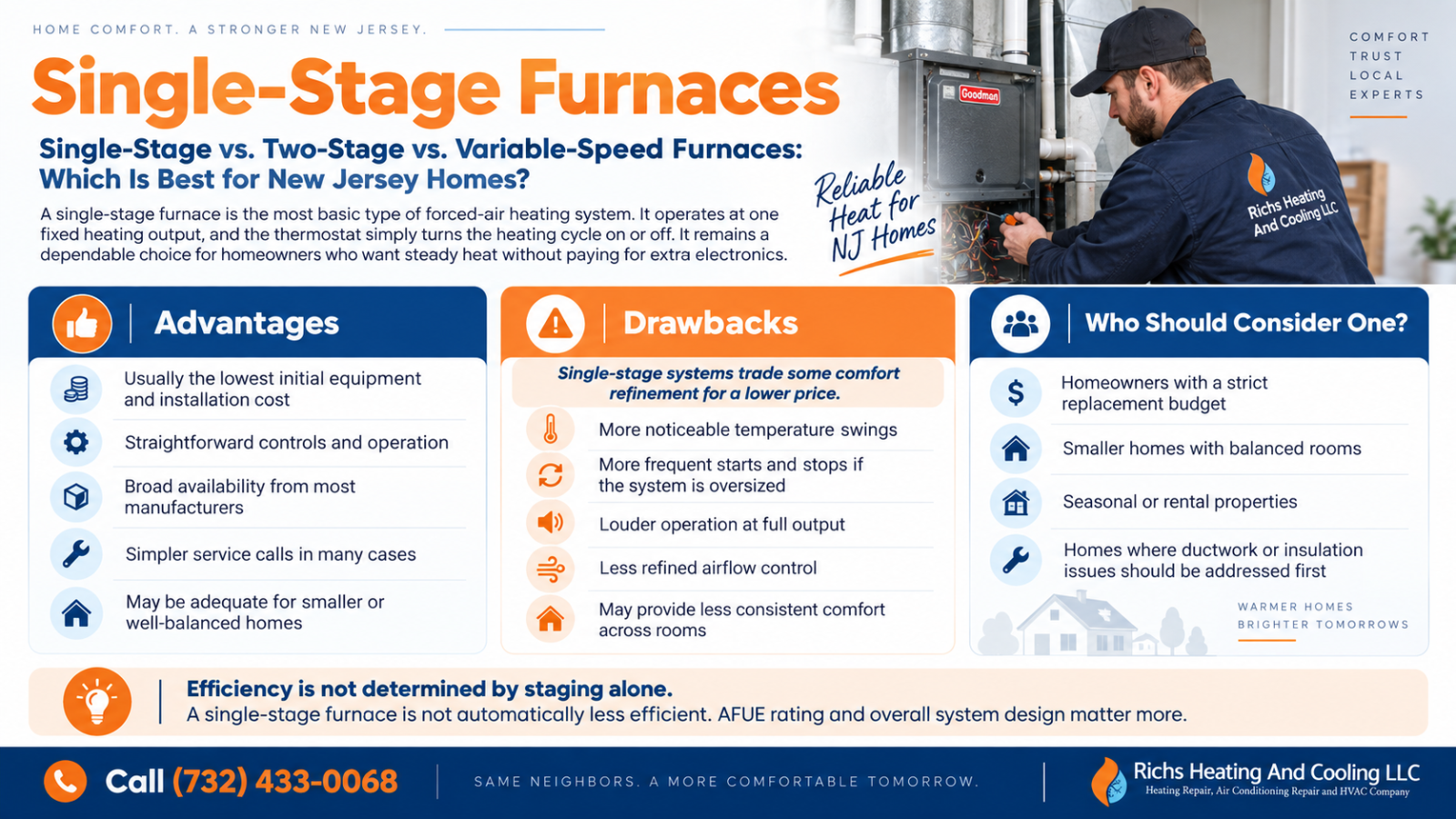
A single-stage furnace is the most basic type of forced-air heating system available today. The burner generally operates at one fixed heating output, and the thermostat simply starts or stops the heating cycle based on your temperature setting. This design has been used for decades and remains widely available from every major manufacturer. It tends to appeal to homeowners who want dependable heat without paying for extra electronics.
Advantages
• Usually the lowest initial equipment and installation cost
• Straightforward controls and operation
• Broad availability from most manufacturers
• Simpler service calls in many cases
• May be adequate for smaller or well-balanced homes
Drawbacks
A single-stage system trades some comfort refinement for its lower price. Temperature swings tend to be more noticeable since the furnace runs at full output every time it cycles on.
• More noticeable temperature swings
• More frequent starts and stops if the system is oversized
• Louder operation at full output
• Less refined airflow control
• May provide less consistent comfort across rooms
Who Should Consider One?
A single-stage model is a reasonable option for homeowners working with a strict replacement budget. It also suits smaller homes with balanced rooms, seasonal or rental properties, and homes where ductwork or insulation issues should be addressed before investing in premium equipment.
Efficiency is not determined by staging alone, so a single-stage furnace is not automatically less efficient. The AFUE rating and overall system design play a bigger role.
Two-Stage Furnaces
A two-stage furnace typically runs a lower heating setting for mild or moderate conditions and switches to a higher setting for colder weather or when recovering from a thermostat setback. The lower stage often runs for longer cycles, which can help distribute heat more evenly than the short, full-output bursts of a single-stage system. Operation still depends on thermostat logic, outdoor conditions, and how the system is configured. Not every two-stage furnace runs in low stage as often as homeowners expect.
Advantages
• Better temperature consistency than many single-stage systems
• Quieter operation during lower-output heating
• Longer, gentler heating cycles
• Often a practical balance between installation cost and performance
• May pair well with a central air conditioner or heat pump when matched correctly
Limitations
A two-stage system costs more upfront than a basic single-stage furnace and includes more components. Benefits depend heavily on proper thermostat compatibility and setup.
• Higher upfront cost than a single-stage model
• More controls and components to maintain
• Full benefits require a compatible thermostat
• A poorly sized furnace may still cycle excessively
• Restrictive ductwork can limit the comfort gains
Who Should Consider One?
Most typical New Jersey homeowners seeking a comfort upgrade land on a two-stage furnace. It suits homes with mild-to-moderate temperature swings, homeowners planning to stay in the property for several years, and households who want quieter operation without paying for the top equipment tier.
A qualified contractor should confirm that your ductwork and thermostat can support the two-stage design before installation.
Variable-Speed and Modulating Furnaces
Variable-speed and modulating are related terms, but they describe two different components. A variable-speed blower adjusts airflow gradually to match system demand. A modulating furnace adjusts burner output in smaller increments than a standard two-stage design. A furnace can have one feature without the other, depending on the specific product. Manufacturer specifications for Carrier's Infinity 98 modulating furnace show premium systems can reach approximately 98% AFUE, although exact efficiency varies by model and configuration.
Advantages
Manufacturer specifications show that premium furnace systems can reach approximately 98% AFUE, although exact efficiency varies by model and configuration. These systems can offer more consistent indoor temperatures and quieter startup and operation.
• More consistent indoor temperatures
• Gradual airflow that may reduce drafts
• Quieter startup and operation
• More continuous air circulation when configured for it
• Greater ability to match output to changing heat demand
Limitations
Variable-speed and modulating equipment carries the highest upfront cost among the three categories. The sophisticated electronics involved can also mean higher repair costs for specialized parts.
• Highest upfront equipment cost
• More sophisticated electronics and controls
• Potentially higher repair costs for specialized components
• Requires a contractor experienced with airflow setup and commissioning
• Energy savings are not guaranteed by the blower type alone
Who Should Consider One?
A variable-speed or modulating system may be appropriate for homeowners prioritizing premium comfort, larger homes with multiple comfort zones, and households sensitive to furnace noise. It also suits homes with compatible central air conditioning and advanced thermostat controls, provided the ductwork and return-air capacity can support it.
Side-by-Side Furnace Comparison
The table describes typical system behavior. Actual performance depends on the model's AFUE rating, blower design, ductwork, thermostat, installation, and maintenance.
 Why New Jersey Climate and Homes Matter
New Jersey homeowners need a system capable of handling sustained winter heating demand, but housing types across the state vary widely. A furnace that performs well in a newer, well-insulated home may struggle in an older home with leaky ductwork or uneven room temperatures. The state's mixed housing stock, from colonials and ranches to split-levels and additions, means no single furnace type fits every property. Duct location, insulation quality, and how rooms were added over time all affect the right choice.
• Geographic differences across northern, central, and southern New Jersey
• Older homes with limited insulation or air leakage
• Ductwork located in attics, crawlspaces, basements, or exterior walls
• Rooms added after the original HVAC system was installed
• Indoor humidity and comfort during winter months
Is High AFUE More Important Than Furnace Type?
AFUE, or Annual Fuel Utilization Efficiency, estimates the percentage of fuel energy converted into usable heat over a heating season. For example, a furnace rated at 95% AFUE converts approximately 95% of the fuel's energy into heat, with the remainder lost through exhaust and operation. AFUE is not the same as your actual utility-bill savings. Savings depend on fuel prices, thermostat settings, insulation, duct losses, and system maintenance.
A properly sized 95% AFUE furnace may perform better for your home than a poorly installed higher-rated system. Some high-efficiency condensing furnaces also require specific venting and drainage conditions that should be reviewed before installation.
Should New Jersey Homeowners Consider Rebates?
New Jersey incentives vary by utility territory, equipment eligibility, and program funding. Some New Jersey utility rebate programs have offered incentives for qualifying natural-gas furnaces at or above 95% AFUE, though amounts and requirements differ by program, so it is worth checking New Jersey's Clean Energy Program for current utility contacts before assuming a specific rebate applies. Confirm whether pre-approval, an authorized contractor, or a post-installation inspection is required.
Which Furnace Is Right for Your Home?
The right furnace type depends on your budget, comfort priorities, and how your home is built. Use the criteria below as a starting point before your consultation.
Choose Single-Stage When
• Lowest upfront cost is the priority
• The home has relatively even temperatures
• The property is smaller or used seasonally
• The homeowner wants simpler controls
Choose Two-Stage When
• The homeowner wants a balance of cost and comfort
• Rooms have moderate temperature differences
• Quieter, longer heating cycles are desirable
• The homeowner expects to remain in the home for several years
Choose Variable-Speed or Modulating When
• Comfort consistency is a major priority
• The household is sensitive to noise or drafts
• The home has uneven heating or multiple zones
• The homeowner accepts a higher initial cost for added control
If your home has major insulation, air-sealing, or ductwork problems, correcting those issues may provide more noticeable comfort improvement than switching furnace types alone.
The Installation Details That Matter Most
Furnace selection should never come down to matching the BTU input of your old unit. A proper furnace installation starts with a room-by-room heat-loss calculation and a full review of your existing ductwork condition. From there, your contractor should verify combustion air, venting, and condensate drainage requirements before finalizing equipment.
• A room-by-room heat-loss calculation
• Verification of existing duct dimensions and condition
• Return-air assessment
• Combustion-air and venting review
• Thermostat compatibility
• Verification of furnace and air conditioner matching
Questions to Ask an HVAC Contractor
Asking the right questions upfront can prevent a mismatched system down the line. Bring this list to your consultation.
• Did you perform a heat-loss calculation for my home?
• Is the quoted furnace single-stage, two-stage, or modulating?
• Does "variable-speed" refer to the blower, the burner, or both?
• What is the furnace's AFUE rating?
• Will my existing ductwork support the recommended airflow?
• What rebates or financing programs may apply?
• What parts and labor warranties are included?
Is the Most Expensive Furnace the Best Value?
Value is not the same as the highest equipment price. The best choice balances installed price against expected service life, comfort improvement, and ongoing maintenance needs. Comparing these factors side by side, rather than focusing on sticker price alone, gives a clearer picture of long-term value.
• Installed price versus expected service life
• Estimated annual fuel use
• Comfort improvement and noise reduction
• Warranty coverage and maintenance requirements
• Available rebates and financing
This guide is intended for general educational purposes. Furnace sizing, equipment compatibility, and installation requirements vary by home and utility territory. A qualified HVAC professional should evaluate the property before a replacement decision is made.
Not Sure Which Furnace Fits Your New Jersey Home?
Rich's Heating and Cooling LLC can evaluate your current system, walk you through single-stage, two-stage, and variable-speed options, and provide a clear quote based on your home's heating needs. Call (732) 433-0068 or contact our team to schedule your consultation today.
Comments