

Yes, New Jersey homeowners may have access to several types of HVAC incentives in 2026, including utility rebates, income-based energy-efficiency programs, whole-home improvement incentives, and certain federal tax benefits. The exact amount available depends on factors like the equipment installed, the utility provider, household income, efficiency ratings, and current program funding. Rebate programs change often, so homeowners should confirm current terms before purchasing any equipment. This guide breaks down what may be available and how to get started.
Before choosing a system, contact Rich's Heating and Cooling LLC for help identifying an efficient HVAC option and requesting a quote.
 What HVAC Rebates May Be Available in New Jersey?
HVAC incentives in New Jersey generally fall into four categories, and understanding the differences helps homeowners know where to start looking. Utility companies offer rebates tied to specific equipment types and efficiency ratings. The state runs broader energy-efficiency and whole-home programs that look at overall household savings. Federal tax credits exist separately from state and utility rebates, with their own eligibility rules tied to the tax year.
• Utility rebates - cover heat pumps, central air conditioners, ductless systems, geothermal equipment, and furnace fans, with eligibility based on utility territory, equipment efficiency, and installation date
• Whole-home programs - target energy-saving HVAC upgrades and broader home improvements based on modeled or measured energy savings and household income
• Income-qualified programs - provide free or reduced-cost efficiency improvements based on household income and utility account status
• Federal incentives - apply to certain qualifying heat pumps and energy-efficiency improvements, subject to tax-year rules and equipment certification
The New Jersey Board of Public Utilities has indicated that federal programs may be stackable with New Jersey Clean Energy incentives, though homeowners should confirm the specific rules for each program before assuming they qualify for both.
Utility HVAC Rebates for New Jersey Homeowners
Utility rebates are often the most practical starting point for homeowners researching HVAC incentives, since eligibility depends directly on the electric or natural-gas provider serving the home. Each utility publishes its own list of qualifying equipment, efficiency thresholds, and rebate amounts. These amounts can change without much notice as program funding is used up or renewed. Homeowners should identify their utility first, then check the current program details before selecting equipment.
JCP&L Rebates
JCP&L's HVAC rebate program lists incentives for several categories of equipment, though homeowners should verify current amounts since these programs are updated periodically. The listed rebates below are based on published program information and are not guaranteed for every applicant.
• Air-source heat pumps - up to $1,000
• Cold-climate heat pumps - up to $1,000
• Ductless mini-split heat pumps - up to $750
• Central air conditioners - up to $200
• Furnace fans - up to $100
• Certain geothermal heat pumps - up to $1,500
The program includes efficiency requirements based on SEER2, EER2, HSPF2, and cold-climate performance ratings, so not every unit on the market will qualify. Homeowners should compare a specific model against JCP&L's current eligible-equipment list before purchasing.
PSE&G Rebates
PSE&G has promoted instant savings on qualifying high-efficiency heating and cooling equipment, though the exact offer depends on the specific model and program terms in effect at the time of purchase. Some sources point to potential savings of up to $1,050, but this figure should be verified against PSE&G's current program page before publishing.
Other New Jersey Utility Programs
Homeowners outside JCP&L and PSE&G territory should not assume they are excluded from HVAC incentives entirely, since most major New Jersey utilities run some version of an efficiency rebate program. Coverage and amounts vary significantly by provider, so the same equipment might qualify for a different rebate depending on which utility serves the home. Program details, deadlines, and eligible-equipment lists are typically published on each utility's own energy-efficiency page. Homeowners should treat these as separate systems rather than assuming statewide consistency.
• Atlantic City Electric
• Rockland Electric
• New Jersey Natural Gas
• Elizabethtown Gas
• South Jersey Gas
Do not assume every utility offers the same rebate structure or dollar amounts as JCP&L or PSE&G. Homeowners should identify their utility first, then review the current equipment list, application deadline, contractor requirements, and documentation rules for that specific program.
First step: Look at a recent utility bill to identify your provider. The utility territory, not just your New Jersey address, often determines which HVAC rebate programs are available.
New Jersey Whole-Home and Energy-Efficiency Incentives
Some New Jersey incentive programs evaluate the entire home's energy performance rather than rewarding a single piece of equipment in isolation. These whole-home programs often require more documentation upfront but can offer larger potential savings for qualifying projects. The process typically starts with an energy assessment and may include testing before and after installation. Household income and home type can also affect how much support is available.
• A home energy assessment
• Pre- and post-installation testing
• Energy modeling
• Documented energy savings
• Approved contractors
• Income verification
• Specific installation timelines
The New Jersey Board of Public Utilities describes HOMES-style incentives as tied to whole-home energy savings, income, home type, and project cost, with different rebate caps for households above and below 80% of area median income. Not every homeowner automatically receives the maximum rebate under these programs, so availability, enrollment, and project qualification should be checked before work begins.
Income-Qualified HVAC Assistance
Homeowners who meet certain income requirements may be eligible for more substantial HVAC support than what standard rebate applicants receive. These programs are typically designed to reduce the upfront cost burden for households that qualify based on income and household size. Eligibility usually depends on documentation, and some programs may require an approved contractor or an energy audit before work starts. Homeowners often need to apply before any purchase or installation takes place.
• Eligibility based on household size and area median income
• Coverage of a high percentage of eligible project costs
• Additional documentation requirements
• Application required before purchase or installation
• Possible energy audit or approved contractor requirement
New Jersey's BPU materials describe higher potential support for households below 80% of area median income under certain federal home-rebate structures. New Jersey's Comfort Partners program is a related resource for eligible households, offering no-cost energy-efficiency measures intended to lower energy use, improve comfort, and reduce utility bills.
Rather than describing these programs as guaranteed free replacements, homeowners should understand they may qualify for no-cost or reduced-cost improvements depending on program rules and funding.
 Federal HVAC Tax Credits in 2026
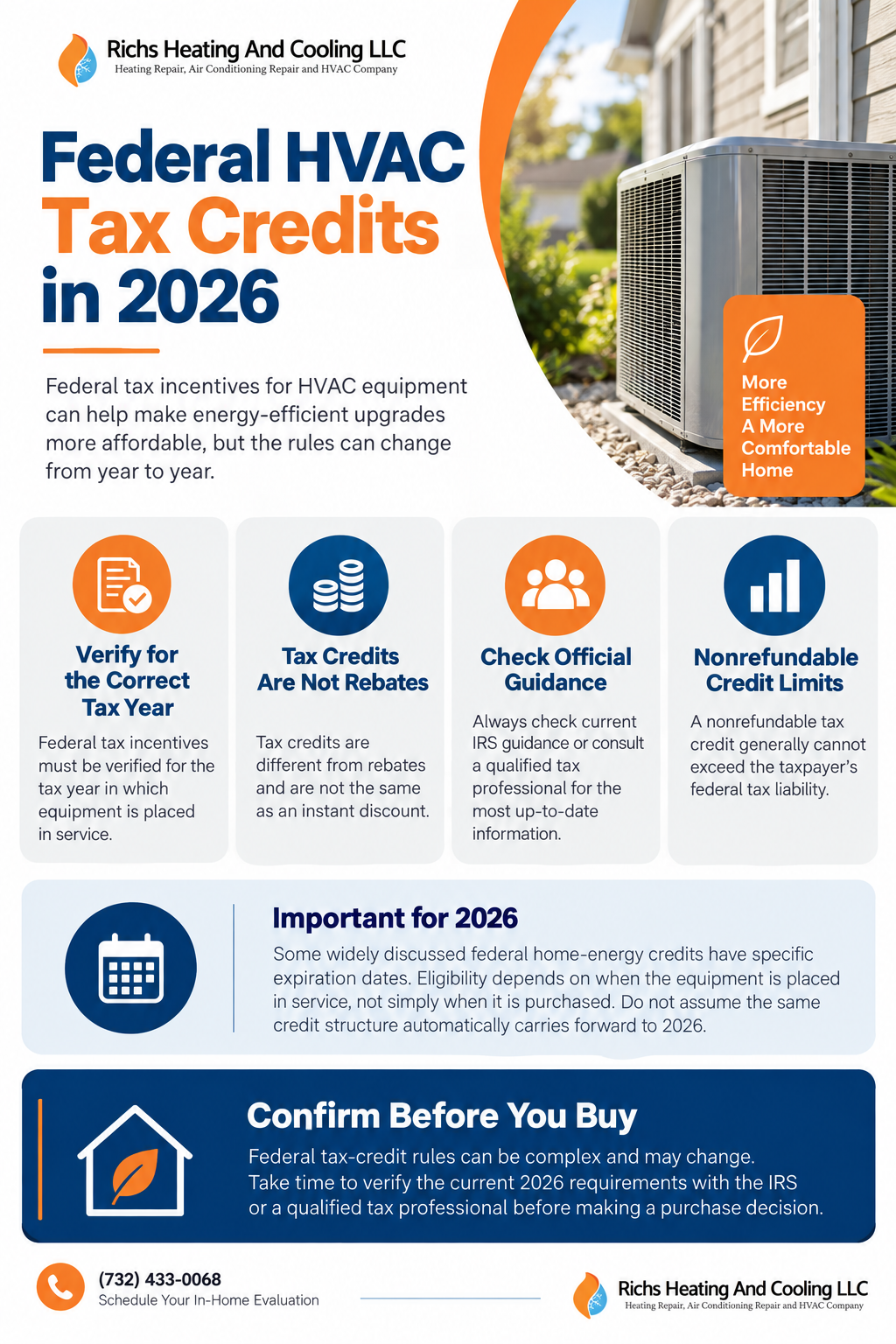
Federal tax incentives for HVAC equipment require particularly careful verification because the rules can shift from one tax year to the next. The IRS has described the Energy Efficient Home Improvement Credit as applying to qualifying property placed in service on or after January 1, 2023, and before December 31, 2025, with a 30% credit and separate annual limits for different equipment categories. Because this article concerns 2026, homeowners should not assume the same credit structure automatically carries forward. Confirming the current tax year rules before making a purchase decision is essential.
• Federal tax incentives must be verified for the tax year in which equipment is placed in service
• Tax credits are different from rebates and are not the same as an instant discount
• Readers should check current IRS guidance or consult a qualified tax professional
• A nonrefundable tax credit generally cannot exceed the taxpayer's federal tax liability
Federal tax-credit rules are especially important to verify for 2026, since some widely discussed federal home-energy credits have specific expiration dates. Eligibility depends on when the equipment is placed in service, not simply when it is purchased, so confirming current IRS requirements or speaking with a tax professional is a necessary step before relying on any federal tax benefit.
Which HVAC Systems May Qualify?
Different types of HVAC equipment are treated differently across New Jersey's various rebate and incentive programs. Understanding which category a system falls into helps homeowners narrow down realistic incentive expectations before shopping. Some systems, like heat pumps, tend to receive more consistent program attention than others. Equipment sizing, installation quality, and certification also play a role in whether a specific unit qualifies.
Heat Pumps
Heat pumps are often the primary focus of New Jersey's efficiency incentive programs because they provide both heating and cooling within a single system. Eligibility typically depends on certification and performance ratings rather than the brand or general marketing claims. Proper sizing and installation quality also affect whether a system performs as expected once installed.
• Air-source or ductless configuration
• ENERGY STAR certification
• SEER2, EER2, HSPF2, or COP ratings
• Cold-climate performance
• Full replacement versus dual-fuel installation
• Proper sizing and installation
• Utility territory
Central Air Conditioners
Some utility programs in New Jersey offer rebates for qualifying high-efficiency central air conditioners, though the rebate amount often depends on the complete matched system rather than a single component. JCP&L's published program lists central-air rebates of $100 or $200 depending on efficiency tier Eligibility may depend on the combined rating of the outdoor unit, indoor coil, and air handler where applicable.
Furnaces and Boilers
Gas furnaces and boilers may qualify under select utility or energy-efficiency programs, though availability varies substantially depending on the specific utility and program in effect. A high AFUE rating alone does not guarantee that a furnace or boiler will qualify for a rebate. Homeowners should check the program's equipment list directly rather than relying on general efficiency marketing.
Ductless Mini-Splits
Ductless systems may qualify for rebates when they meet a program's specific efficiency standards. These systems can be especially useful for additions, converted spaces, homes without existing ductwork, and rooms with persistent comfort issues. Rich's Heating and Cooling offers guidance on whether a ductless setup makes sense for a given space before a rebate application is submitted.
Geothermal Heat Pumps
Geothermal incentives may be available through utility or federal programs, though installation costs and site requirements make this option more complex than other HVAC upgrades. Loop requirements and specialized system design can affect both the project timeline and the final eligible rebate amount. Homeowners considering geothermal should budget extra time for both installation planning and incentive research.
 How Much Can New Jersey Homeowners Save?
There is no single rebate figure that applies to every New Jersey homeowner, since savings can range from a modest utility rebate to several thousand dollars under qualifying whole-home or income-based programs. The final number depends on a combination of factors specific to the home and the equipment chosen. Some programs provide instant savings at the point of purchase, while others require the homeowner to pay first and apply for reimbursement afterward. Understanding which model applies to a given program helps set realistic expectations.
• Equipment type
• Efficiency rating
• Utility provider
• Household income
• Whether the project is a full electrification or partial upgrade
• Whether electrical-panel work is required
• Whether the project includes insulation or air sealing
• Whether the application is submitted before installation
• Program funding and expiration dates
• Whether incentives can be combined
A rebate is not the same as an immediate discount on every installation. Some programs provide instant savings, while others require the homeowner to pay first and submit an application with invoices, model numbers, AHRI documentation, permits, and proof of installation.
Can HVAC Rebates Be Combined?
Combining multiple HVAC rebates is sometimes possible in New Jersey, but it is not automatic and depends heavily on how each program is structured. Some programs are funded by the same source and explicitly prohibit stacking, while others may allow combination under specific conditions. Whether a rebate is based on total project cost also affects how much can be claimed across multiple programs. Homeowners should never assume compatibility without checking directly with each program administrator.
• Whether the programs are funded by the same source
• Whether each program permits combination with other incentives
• Whether the rebate is based on project cost
• Whether the same equipment is being claimed twice
• Whether a federal tax rule requires certain rebates to be deducted from eligible expenses
• Whether total incentives exceed the allowable share of project costs
The IRS has explained that some utility rebates and purchase-price-related rebates may need to be subtracted when calculating a federal credit, while state incentives may receive different tax treatment depending on how they are structured. Homeowners should ask the contractor or program administrator for written confirmation before assuming that rebates can be stacked.
New Jersey HVAC Rebate Eligibility Checklist
Before assuming a rebate applies to a specific project, homeowners can use the following checklist to confirm the basics are in place. This list covers the most common requirements across New Jersey's various utility, state, and federal programs. Meeting every item here does not guarantee approval, since individual program rules still apply. It does, however, reduce the risk of an easily avoidable denial.
• The homeowner owns or occupies an eligible New Jersey residence
• The equipment is new, not used
• The model appears on the program's eligible-equipment list
• The system meets the required efficiency ratings
• The installation is completed within the program's eligible dates
• The contractor meets licensing or participation requirements
• Required permits are obtained
• The homeowner applies before the deadline
• Invoices and proof of payment are retained
• AHRI certificates, model numbers, and serial numbers are available
• The rebate is not already claimed under another incompatible program
• The homeowner confirms tax treatment with a qualified professional
How to Apply for an HVAC Rebate
Applying for an HVAC rebate in New Jersey generally follows a predictable sequence, even though the specific forms and portals differ by program. Starting the process before purchasing equipment gives homeowners more flexibility to choose a qualifying system. Some programs require preapproval or an energy audit, so confirming this early avoids wasted time. Keeping thorough documentation throughout the project also makes the application process smoother.
• Identify the electric and gas utilities serving the home
• Review current rebate rules before purchasing equipment
• Schedule an evaluation with a qualified HVAC contractor
• Compare eligible system options and efficiency ratings
• Ask whether preapproval, an audit, or a participating contractor is required
• Confirm permits and installation requirements
• Keep the proposal, invoice, model numbers, serial numbers, AHRI certificate, and proof of payment
• Complete the application before the deadline
• Confirm whether the rebate is instant, contractor-administered, or paid afterward
• Retain all records for tax and warranty purposes
Do not purchase equipment solely because a manufacturer calls it "high efficiency." Rebate programs use their own eligibility lists and technical requirements that may differ from general marketing claims.
Common Mistakes That Can Cause a Rebate Denial
Even homeowners who plan carefully can run into avoidable denials if certain details are missed during the process. Many of these mistakes involve timing, documentation, or assumptions about equipment eligibility. Reviewing this list before starting a project can help homeowners avoid the most frequent pitfalls. Working with a contractor familiar with rebate documentation also reduces the risk of errors.
• Installing equipment before receiving required approval
• Choosing a qualifying outdoor unit but an ineligible matched indoor component
• Missing the program deadline
• Hiring a contractor who does not meet program requirements
• Failing to obtain permits
• Submitting an incomplete invoice
• Omitting model and serial numbers
• Assuming an older rebate amount still applies
• Claiming two incentives that cannot be combined
• Confusing a tax credit with a direct rebate
• Assuming an advertised "up to" amount is guaranteed
• Ignoring income-verification requirements
How Rich's Heating and Cooling Can Help
Navigating New Jersey's rebate landscape is easier with a contractor who understands both the equipment side and the documentation homeowners need. Rich's Heating and Cooling LLC works with homeowners throughout the Dunellen area to evaluate heating and cooling needs before recommending a system. The company offers installation, maintenance, repair, heat pump, and boiler services, giving homeowners multiple options to discuss during a single consultation. A written estimate helps homeowners understand costs upfront before committing to a project.
• Evaluate the home's heating and cooling needs
• Discuss replacement, repair, heat pump, boiler, and air-conditioning options
• Recommend equipment based on comfort, efficiency, budget, and home layout
• Explain which model information may be needed for rebate research
• Provide a written estimate
• Help homeowners understand installation requirements
• Complete quality installation and inspect system performance
Wondering whether your New Jersey HVAC upgrade may qualify for an incentive? Contact Rich's Heating and Cooling LLC at (732) 433-0068 to discuss your home, equipment options, and next steps. Ask for a no-obligation quote before starting your project.
Rich's Heating and Cooling cannot guarantee rebate approval, since final decisions belong to the program or tax-credit administrator handling the application.
Comments